
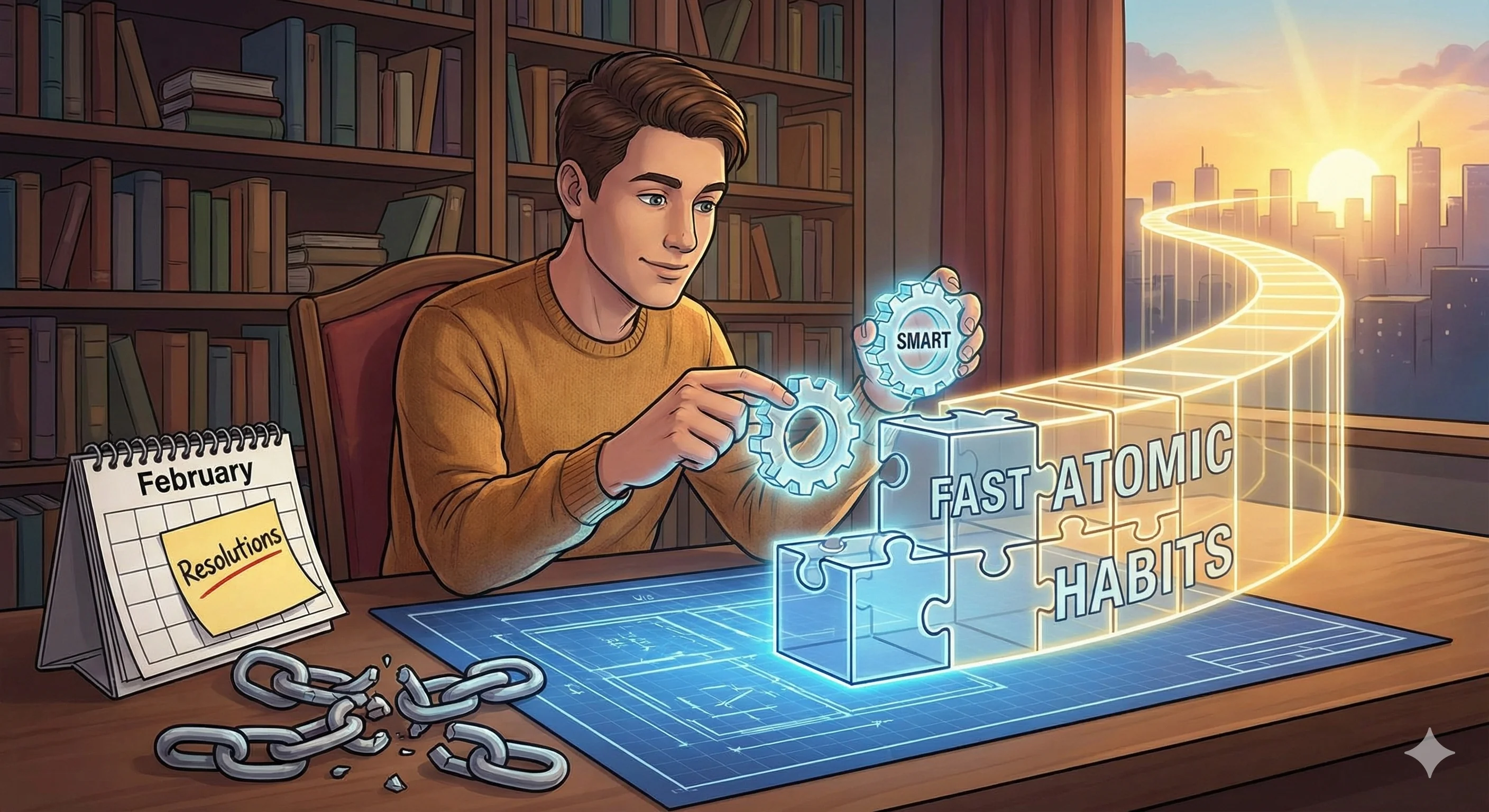
The problem with New Year's resolutions
Every January, millions of people set ambitious goals. Lose weight. Learn a new skill. Get promoted. Save more money. And by February? Studies suggest that roughly 80% of New Year's resolutions fail. The enthusiasm fades, the gym membership goes unused, and by March we're back to our old patterns wondering what went wrong.
But here's the thing: the problem isn't you. It's the way most people set goals. Vague intentions like "get healthier" or "be more productive" aren't goals—they're wishes. And wishes don't come with instruction manuals.
What if you could approach your resolutions differently this year? What if, instead of hoping for change, you could engineer it? That's exactly what proven goal-setting frameworks and habit science allow you to do. Let's break down how to turn your New Year's resolutions from wishful thinking into achievable outcomes.
Why most resolutions fail
Before we dive into solutions, it helps to understand why traditional resolutions don't stick. Most resolutions fail for predictable reasons: they're too vague, too ambitious without a plan, never discussed or reviewed, and completely invisible to anyone who might hold you accountable.
Consider the difference between "I want to get in shape" and "I will walk for 20 minutes every morning before work, starting January 2nd, and I'll track my progress on my phone's health app." The first is a hope. The second is a plan.
The good news? Researchers and organizational psychologists have spent decades developing frameworks that transform vague aspirations into achievable goals. Two of the most effective are SMART goals and FAST goals—and when you combine them with the science of habit formation, you've got a powerful system for real change.
Understanding goal-setting frameworks
SMART goals: the classic foundation
SMART goals have been around since the 1980s, and for good reason—they work. SMART stands for Specific, Measurable, Achievable, Relevant, and Time-bound. Each element forces you to clarify what you actually want.
Specific: What exactly do you want to accomplish? "Lose weight" becomes "Lose 15 pounds."
Measurable: How will you track progress? "Lose 15 pounds, tracked weekly on Saturday mornings."
Achievable: Is this realistic given your current situation? Losing 15 pounds over six months is sustainable; losing 50 pounds in one month is not.
Relevant: Does this goal matter to you? Are you pursuing it for your own reasons, or because you feel like you should?
Time-bound: When will you achieve this? "Lose 15 pounds by June 30th."
SMART GOAL EXAMPLE
Vague resolution: "I want to read more."
SMART version: "I will read 24 books this year (2 per month), tracking my progress in Goodreads, choosing books from my wishlist that expand my professional knowledge, with a completion deadline of December 31st."
FAST goals: built for momentum
While SMART goals provide structure, FAST goals add something crucial: visibility and ambition. FAST stands for Frequently discussed, Ambitious, Specific, and Transparent. This framework was developed to address a key weakness in traditional goal-setting—goals that are set once and forgotten.
Frequently discussed: How and when will you review progress? Goals that get regular attention stay top of mind. You might schedule weekly self-reviews, monthly check-ins with a friend, or use a habit tracking app that prompts daily reflection.
Ambitious: Does this goal stretch you? FAST goals encourage aiming higher than what feels comfortable. The target should inspire you to work harder than you otherwise would.
Specific: Like SMART, clarity is essential. What exactly are you trying to accomplish?
Transparent: Who knows about your goal? Making goals visible creates accountability. Share them with friends, family, colleagues, or even publicly on social media.
FAST GOAL TEMPLATE
- Define your specific goal - What exactly will you accomplish?
- Set an ambitious target - Make it a stretch, not a guarantee
- Schedule frequent discussions - Weekly reviews, monthly check-ins
- Make it transparent - Share with accountability partners, track publicly
FAST GOAL EXAMPLE
Goal: Launch a side business generating $1,000/month in revenue by December 31st.

Frequently Discussed: Weekly Sunday planning sessions to review progress, monthly video calls with a mentor, and daily habit tracking in an app.

Ambitious: $1,000/month is a stretch goal—it would require building something real, not just dabbling.

Specific: Launch an online course teaching Python basics to beginners, with a target of 50 paid enrollments at $20 each per month.

Transparent: Share monthly progress updates on LinkedIn, join an entrepreneur accountability group, and tell close friends about the goal.
Combining SMART and FAST
These frameworks aren't competing—they're complementary. SMART gives you the structure to define a clear, achievable goal. FAST adds the momentum, accountability, and ambition that keep you moving. The most effective approach uses elements from both.
A helpful guideline: keep your total goals limited to four or five at most. Research suggests that spreading attention across too many objectives reduces your chances of achieving any of them. Of those four to five goals, focus one or two on performance (outcomes you want to achieve) and one or two on development (skills or capabilities you want to build).
Using AI to transform your goals
Here's where AI becomes your personal goal-setting coach. Instead of staring at a blank page trying to transform vague intentions into structured goals, you can use a prompt to do the heavy lifting. The following prompt will take any resolution and turn it into a complete SMART + FAST goal with supporting details.
GOAL TRANSFORMATION PROMPT
Copy and paste this prompt into ChatGPT, Claude, or your preferred AI assistant:
I want to transform a vague goal into a structured, achievable goal using the SMART and FAST frameworks combined.

My goal is: [INSERT YOUR GOAL HERE]

Please help me create a complete goal plan that includes:

1. SMART BREAKDOWN:
- Specific: What exactly will I accomplish?
- Measurable: How will I track progress? What metrics will I use?
- Achievable: Is this realistic? If not, suggest a more achievable version.
- Relevant: Why does this matter? (Ask me if you need context)
- Time-bound: What's the deadline?

2. FAST BREAKDOWN:
- Frequently Discussed: How and when should I review progress? Suggest a schedule.
- Ambitious: Is this goal stretching me enough? If it's too easy, suggest a more ambitious target.
- Specific: Confirm the specific outcomes and actions.
- Transparent: Who should know about this goal? How can I build accountability?

3. FINAL COMBINED GOAL: Write the complete goal as one clear statement that incorporates both frameworks.

4. SUGGESTED ATOMIC HABITS: What 2-3 small daily or weekly habits would make this goal inevitable? Use the format "After I [existing habit], I will [new habit]."

Please ask me any clarifying questions before generating the goal plan.
TIPS FOR BETTER RESULTS
- Be honest about your starting point—the AI can suggest more realistic targets
- Include context about your schedule, resources, and constraints
- Ask follow-up questions if any part of the plan doesn't fit your situation
- Request alternatives if the suggested habits don't match your routine
- Use the conversation to refine until the goal feels both ambitious and achievable
The AI will ask clarifying questions to understand your situation, then generate a complete goal plan. You can iterate on it, adjust the ambition level, or ask for different habit suggestions until you have something that feels right.
Real-world goal transformations
Let's walk through several common New Year's resolutions and see what well-structured goals look like using these frameworks. These examples show the kind of output you can expect when using the prompt above.
Example 1: career advancement
SCENARIO: You want to advance your career this year, maybe get a promotion or move to a better role.
TRANSFORMATION
Vague resolution: "I want to get promoted this year."
SMART + FAST version: "I will earn a promotion to Senior Manager by Q3 by completing two cross-departmental projects, building visibility with leadership through monthly 1:1s, and documenting my achievements in a portfolio reviewed quarterly with my manager."
FAST BREAKDOWN
Frequently Discussed: Quarterly portfolio reviews with manager, monthly leadership 1:1s
Ambitious: Senior Manager is a stretch—it requires demonstrating cross-functional impact
Specific: Two cross-departmental projects, documented achievements, timeline by Q3
Transparent: Manager and leadership team are aware, progress is formally tracked
Example 2: health and fitness
SCENARIO: You want to improve your health and lose some weight.
TRANSFORMATION
Vague resolution: "I want to get in shape."
SMART + FAST version: "I will lose 20 pounds by June 30th by walking 8,000 steps daily, strength training 3 times per week, and tracking calories in MyFitnessPal. I'll do weekly weigh-ins every Saturday and share monthly progress with my workout partner."
FAST BREAKDOWN
Frequently Discussed: Weekly weigh-ins, monthly progress shares with workout partner
Ambitious: 20 pounds in 6 months requires consistent effort but is achievable
Specific: 8,000 steps, 3 strength sessions, calorie tracking, clear deadline
Transparent: Workout partner provides accountability, app tracking creates visibility
Example 3: financial goals
SCENARIO: You want to improve your financial situation and save more money.
TRANSFORMATION
Vague resolution: "I want to save more money."
SMART + FAST version: "I will save $10,000 for an emergency fund by December 31st by automatically transferring $385 every two weeks to a high-yield savings account, cutting dining out to twice monthly, and reviewing my budget every Sunday evening."
FAST BREAKDOWN
Frequently Discussed: Weekly Sunday budget reviews
Ambitious: $10,000 requires discipline and behavior change
Specific: $385 bi-weekly, dining out 2x/month, high-yield savings account
Transparent: Automated transfers create accountability, tracking app shows progress
Example 4: learning a new skill
SCENARIO: You want to learn Python programming this year.
TRANSFORMATION
Vague resolution: "I want to learn to code."
SMART + FAST version: "I will achieve Python proficiency by completing a 12-week online course by March 31st, then building three personal projects by June 30th. I'll study 30 minutes daily before work, share weekly progress in a Discord community, and document my learning journey in a blog."
FAST BREAKDOWN
Frequently Discussed: Weekly Discord community shares, blog updates
Ambitious: From zero to three personal projects in 6 months is challenging
Specific: 12-week course, 3 projects, 30 minutes daily, clear deadlines
Transparent: Public blog, community involvement, progress visible to others
Example 5: improving relationships
SCENARIO: You want to strengthen relationships with family and friends.
TRANSFORMATION
Vague resolution: "I want to be a better friend."
SMART + FAST version: "I will deepen my five closest friendships by scheduling one meaningful connection each week—either in-person, by video call, or through a thoughtful message. I'll use a simple tracker to ensure I'm reaching out to each person at least twice monthly, and I'll plan one memorable experience with each friend by year-end."
FAST BREAKDOWN
Frequently Discussed: Weekly connection reviews, tracker check-ins
Ambitious: Consistent, intentional connection requires overcoming busy schedules
Specific: 5 friends, 1 connection weekly, 2x monthly minimum, 5 experiences by year-end
Transparent: Shared with spouse/partner who can help with accountability
The secret ingredient: atomic habits
Frameworks give you a destination. Habits give you the vehicle. James Clear's "Atomic Habits" popularized a crucial insight: lasting change comes from building systems, not just setting goals. The difference? Goals are about the results you want to achieve. Systems are about the processes that lead to those results.
An atomic habit is a small, consistent behavior that compounds over time. The word "atomic" means tiny, fundamental, and powerful—just like atoms. By focusing on 1% improvements, you build momentum that transforms your identity and your outcomes.
The four laws of behavior change
Clear's framework identifies four levers you can pull to build or break habits:
1. Make it obvious - Design your environment so the cue for your habit is visible. Want to read more? Put a book on your pillow. Want to work out? Lay out your gym clothes the night before.
2. Make it attractive - Bundle habits with things you enjoy. Listen to your favorite podcast only while exercising. Pair study sessions with your favorite coffee.
3. Make it easy - Reduce friction. The smaller the habit, the more likely you'll do it. Two minutes of reading is better than zero. Five pushups beats skipping the workout entirely.
4. Make it satisfying - Reward yourself immediately. Use a habit tracker where you can see the chain of completed days. Celebrate small wins.
HABIT STACKING
One of the most powerful techniques from Atomic Habits is habit stacking—linking a new behavior to an existing one. The formula is simple:
"After I [CURRENT HABIT], I will [NEW HABIT]."
- After I pour my morning coffee, I will write in my journal for 5 minutes.
- After I sit down at my desk, I will write down my three priorities for the day.
- After I brush my teeth at night, I will read one page of my book.
- After I get home from work, I will change into my workout clothes.
Starting small: the two-minute rule
When building new habits, there's a powerful technique called the two-minute rule: when you start a new habit, it should take less than two minutes to do. This isn't about limiting yourself permanently—it's about making the habit so easy that you can't say no.
"Read 30 books this year" becomes "read one page before bed." "Run a marathon" becomes "put on my running shoes." "Write a novel" becomes "write one sentence." The point is to become the type of person who shows up consistently. Identity precedes achievement.
TWO-MINUTE VERSIONS OF COMMON GOALS
- Goal: Meditate for 20 minutes daily → Start: Sit in meditation position for 2 minutes
- Goal: Study for certification → Start: Open the study material and read one paragraph
- Goal: Exercise regularly → Start: Do 2 pushups after waking up
- Goal: Eat healthier → Start: Eat one piece of fruit with breakfast
- Goal: Learn a language → Start: Practice one flashcard
Connecting habits to your goals
Here's where everything comes together. Your goals (defined using SMART and FAST) tell you where you're going. Your atomic habits are the daily actions that get you there. The key is identifying the specific behaviors that, if performed consistently, will inevitably lead to your goal.
Example: connecting goals and habits
SCENARIO: Your FAST goal is to earn a promotion to Senior Manager by Q3.
SUPPORTING ATOMIC HABITS
Daily habit: After I arrive at my desk, I will spend 10 minutes updating my achievement log with yesterday's wins.

Weekly habit: Every Friday at 3 PM, I will send my manager a brief update on project progress.

Monthly habit: On the first Monday of each month, I will schedule a 30-minute coffee chat with someone in leadership.

Cue: Calendar reminders set for each behavior
Reward: Check-mark on habit tracker, visible streak count
Notice how the big, ambitious goal breaks down into small, repeatable behaviors. You're not hoping for a promotion—you're becoming the type of person who documents achievements, communicates proactively, and builds relationships. The promotion becomes a natural consequence.
Building your accountability system
The "Transparent" component of FAST goals isn't just nice to have—it's essential. Social accountability dramatically increases follow-through. There are several ways to build this into your resolution system.
Accountability partners: Find someone pursuing similar goals and check in weekly. Share wins, discuss obstacles, and hold each other to commitments.
Public commitment: Tell people about your goals. Post about them on social media. The mild social pressure of public commitment increases motivation.
Progress tracking: Use apps, spreadsheets, or paper trackers that make your streaks visible. The simple act of tracking creates awareness and motivation.
Regular reviews: Schedule time to assess your progress. Weekly reviews catch small slips before they become months of inactivity. Monthly reviews help you adjust strategies that aren't working.
WEEKLY REVIEW QUESTIONS
- Did I complete my habit targets this week?
- What obstacles did I encounter?
- What will I do differently next week?
- Am I still on track for my larger goal?
- Do I need to adjust my approach?
When you fall off track (because you will)
Here's an important truth: you will miss days. You will skip workouts, break your diet, forget to practice. This is normal. What separates those who achieve their goals from those who abandon them isn't perfection—it's how they respond to setbacks.
The key principle: never miss twice. Missing once is an accident. Missing twice is the start of a new habit. If you miss a workout on Monday, make Tuesday non-negotiable. If you overspend in the first week of the month, double down on discipline in week two.
Another useful reframe: think in terms of batting averages, not perfection. Baseball players who hit .300 are all-stars. That means they fail 70% of the time. If you maintain your habits 80% of days over a year, you'll achieve remarkable results—far better than the person who gave up after their first slip.
Putting it all together: your action plan
Here's a step-by-step process for turning your New Year's resolutions into achievable outcomes.
YOUR RESOLUTION ACTION PLAN
- Limit your goals: Choose 4-5 maximum, with a mix of performance and development goals
- Apply SMART criteria: Make each goal Specific, Measurable, Achievable, Relevant, Time-bound
- Add FAST elements: Plan for frequent discussion, ambitious targets, and transparency
- Identify supporting habits: What daily/weekly behaviors will make the goal inevitable?
- Apply the two-minute rule: Make your starter habits impossibly small
- Stack habits: Link new behaviors to existing routines
- Design your environment: Make cues obvious and friction low
- Build accountability: Find partners, track publicly, schedule reviews
- Plan for setbacks: Accept imperfection, never miss twice, focus on long-term batting average
KEY TAKEAWAYS
- Vague resolutions fail because they lack structure, visibility, and daily reinforcement
- SMART goals provide clarity: Specific, Measurable, Achievable, Relevant, Time-bound
- FAST goals add momentum: Frequently discussed, Ambitious, Specific, Transparent
- Atomic habits are the daily actions that make goals inevitable—start with two-minute versions
- Habit stacking links new behaviors to existing routines for automatic cuing
- Accountability and transparency dramatically increase follow-through
- Perfection isn't the goal—consistency over time is what matters
REMEMBER
- Goals determine your destination; habits determine whether you arrive
- Never miss twice—respond to setbacks with immediate action
- Identity precedes achievement: become the type of person who shows up consistently
- Review frequently and adjust as needed—goals aren't set in stone
The bigger picture
New Year's resolutions get a bad reputation because most people approach them as wishes rather than projects. But when you apply proven frameworks—when you make goals specific, ambitious, and transparent, when you break them into daily atomic habits, when you build systems for accountability and recovery—something shifts.
You stop hoping for change and start engineering it. You stop being the person who sets resolutions and becomes someone who builds the life they want, one small habit at a time.
This year can be different. Not because of willpower or motivation—those fade. But because you've now got the tools to turn aspirations into actions, and actions into identity. The question isn't whether these frameworks work. The question is whether you'll use them.
Pick your goals. Make them SMART and FAST. Identify the atomic habits that will get you there. Start small. Track your progress. Share with others. And when you stumble—because you will—remember: never miss twice.
Here's to a year of actually achieving what you set out to do.
Want to learn more about using AI in practical, everyday situations? Check out Practical AI for Humans for comprehensive guides on prompt engineering, AI tools, and real-world applications that make your life easier.