It Started as a Simple Golf Trip
Planning a golf trip for your regular foursome is straightforward. Pick a date, find a course, book a tee time, maybe grab dinner after. You could knock it out in twenty minutes between meetings.
Now multiply that by eighteen. Seventy-two golfers. Participants flying in from six different states. Four full courses, a par-3 course, a putting contest, lodging for everyone, group meals, and coordinated tee times across four days. What started as "we should do something bigger this year" quickly became a logistical nightmare that would make event planners weep.
The Complexity Explosion
Here's where things get real. With 72 people, you're not just booking tee times—you're solving a multi-variable optimization problem that touches every part of the trip:
Venue selection alone becomes overwhelming. Most golf resorts can't accommodate 72 players across multiple rounds without disrupting their regular members and guests. You need courses within reasonable proximity to each other, lodging that can house everyone (ideally together for the group experience), and facilities that can handle group dining. Try Googling "golf resorts for 72 people" and see how far that gets you.
The logistics cascade from there. Participants coming from six states means coordinating arrival times from multiple airports. Different flight schedules affect when people can play, which affects pairings, which affects tee times. Someone landing at 2 PM can't make a morning round. Now multiply that consideration across 72 schedules.
How AI Changed the Game
This is where AI became indispensable. Instead of drowning in spreadsheets and browser tabs, the trip organizer used AI as a planning partner to systematically work through each layer of complexity.
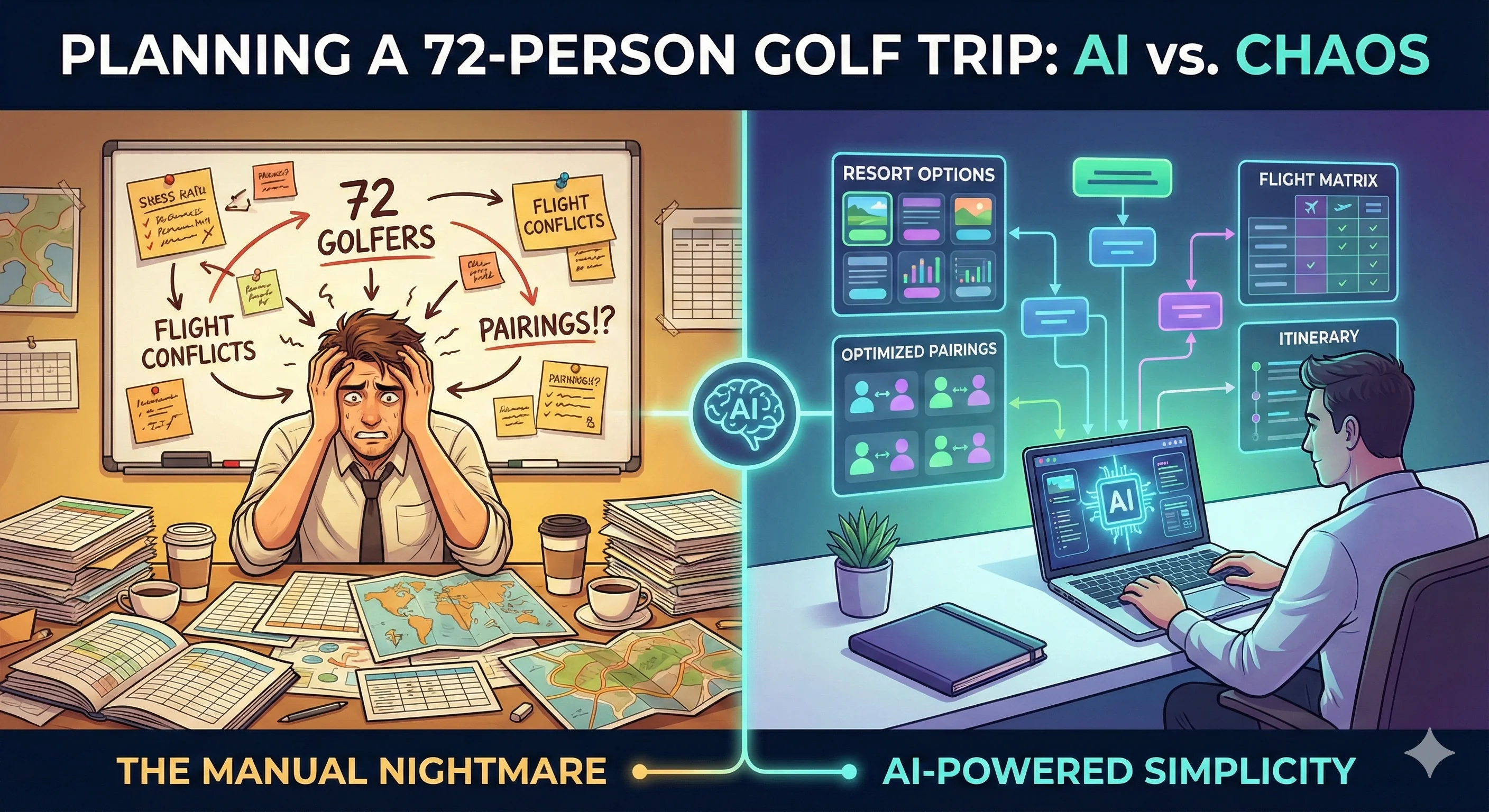
For venue research, AI helped identify resorts that could actually handle the group size by analyzing capacity requirements: 72 beds minimum (with room configurations that work for a guys' trip), four courses available for block bookings, on-site or nearby par-3 options, banquet facilities for group dinners, and geographic clusters that minimize transit between courses.
For flight logistics, AI processed departure cities and arrival windows to map out realistic schedules—identifying which airports to fly into, what arrival times would allow for Day 1 activities, and how to group travelers on similar itineraries.
For the pairings and tee times, AI tackled what would've been a brutal manual task: creating foursomes across four rounds while ensuring variety (so you're not stuck with the same three guys all week), balancing skill levels, and accounting for special requests. That's 18 groups per round across 4 rounds—72 individual placement decisions made four times over.
WHAT AI HANDLED
- Researching and filtering resorts by capacity, amenities, and course availability
- Analyzing flight options and grouping travelers by departure region
- Generating foursome pairings with variety and skill-level balance
- Creating tee time grids that account for travel logistics
- Drafting F&B estimates based on group size and venue options
- Building itineraries that sync activities across all 72 participants
What This Would Look Like Without AI
Let's be honest about the alternative. Without AI assistance, planning this trip would require:
Venue research: Manually calling or emailing dozens of resorts, explaining your requirements each time, waiting for responses, comparing options in a sprawling spreadsheet. Figure 20+ hours just on this phase, spread across weeks of back-and-forth.
Flight coordination: Collecting travel preferences from 72 people (good luck getting timely responses), cross-referencing arrival times, manually identifying conflicts. Someone always books the wrong day.
Pairings: This is where it gets brutal. Creating balanced foursomes for one round is manageable. Doing it four times while ensuring everyone plays with different people? You're looking at a whiteboard covered in names and arrows, hours of shuffling, and inevitably someone complaining they played with the same person three times.
The putting contest and par-3 scheduling alone would eat an afternoon—figuring out when 72 people rotate through without bottlenecks while the main rounds are happening.
Conservative estimate: 60-80 hours of planning work, much of it tedious coordination that leaves room for human error at every step.
The Practical Takeaway
You don't need to be planning a 72-person golf trip to benefit from this approach. The principle scales down beautifully. Planning a family reunion for 25 people across three cities? AI can help. Coordinating a corporate offsite with multiple breakout sessions? Same playbook.
The key insight is recognizing when you've crossed the threshold from "I can handle this in my head" to "this has too many moving parts." For golf trips, that line is probably somewhere around 16-20 people. Once you're managing multiple courses, lodging blocks, and group activities, the complexity earns the AI assist.
KEY TAKEAWAY
AI excels at exactly the kind of multi-variable coordination that makes large group logistics a nightmare. It doesn't get overwhelmed by 72 names, doesn't lose track of who's arriving when, and doesn't mind regenerating the pairings when someone drops out two weeks before the trip. Use it for the tedious coordination work so you can focus on what actually matters—making sure everyone has a great time.
Want to learn more? Check out Practical AI for Humans for more practical guides on using AI effectively.