
The Most Expensive Decision You'll Make on Incomplete Information
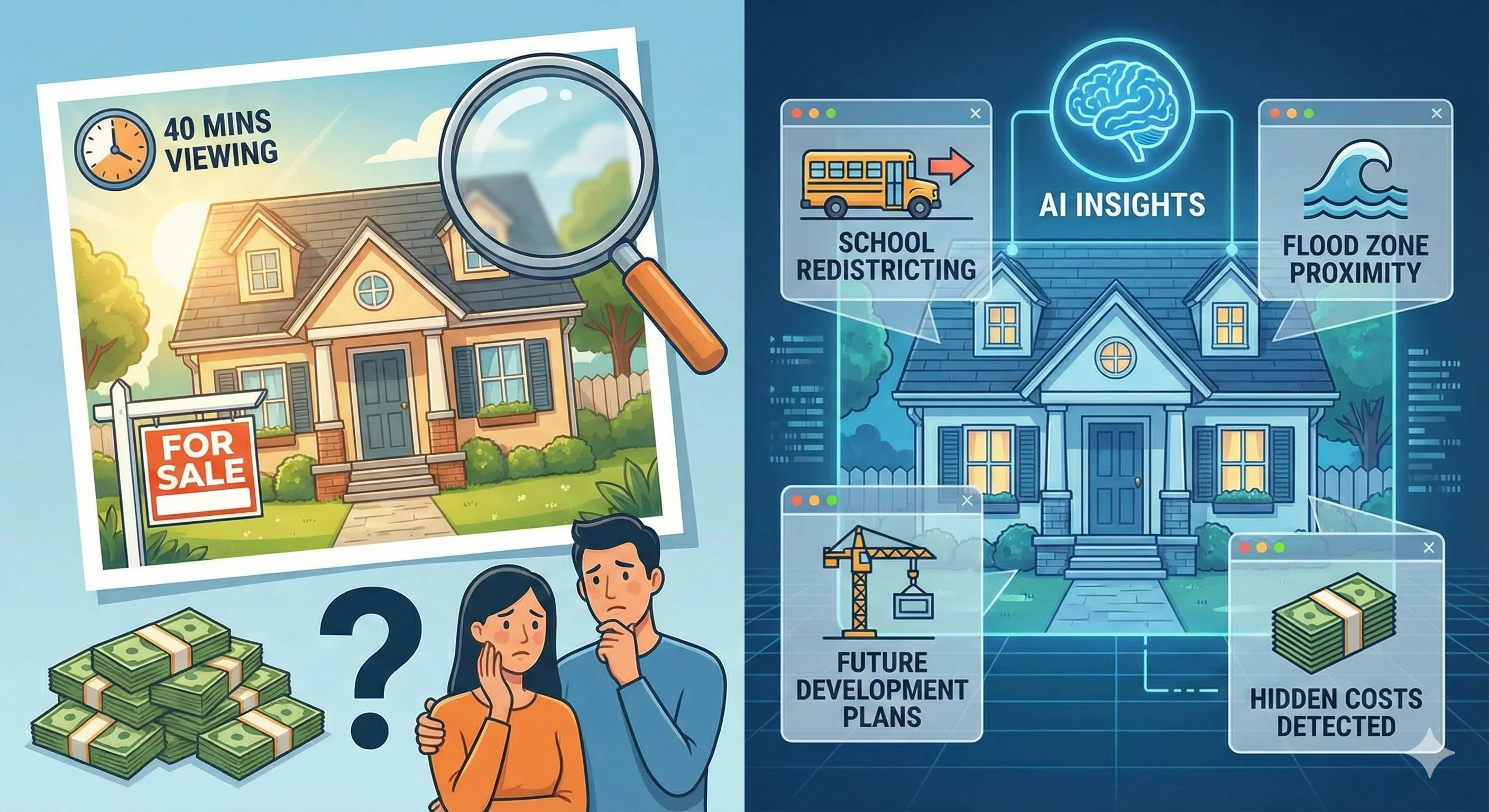
You're about to spend $300,000—maybe $500,000, maybe more—on a house you've walked through twice for a total of forty minutes. You've Googled the address, scrolled through Zillow photos, and driven past at different times of day. But do you actually know what you're buying into?
The listing won't mention the proposed highway expansion two miles away. The seller's disclosure doesn't cover the neighbor who runs a loud car repair hobby every Saturday. The charming "up-and-coming neighborhood" description doesn't explain that the nearest grocery store closed last year and nothing has replaced it. These are the things you discover after you've signed, moved in, and realized your due diligence had gaps you didn't know existed.
Why AI Changes Your Research Game
Real estate agents are helpful, but they're incentivized to close deals. Online reviews are scattered and often outdated. And you simply don't have time to become an expert in flood zones, school redistricting proposals, and municipal development plans for every neighborhood you're considering.
AI can't visit the house for you or tell you if you'll love the kitchen. But it can synthesize public information, generate targeted research questions, and help you build a due diligence checklist that covers blind spots you wouldn't think to investigate. Think of it as a research assistant who's read every neighborhood guide, every city planning document, and every "things I wish I knew before buying" Reddit thread—and can apply all of it to your specific situation.
The Home Buyer's Research Prompt
Before you make an offer—ideally before you even get emotionally attached—run the property through a comprehensive research framework. Here's the prompt that surfaces what listings hide:
THE HOME BUYING RESEARCH PROMPT
I'm considering buying a home at [address or neighborhood] in [city, state]. Help me conduct thorough due diligence before making an offer.
About my situation:
- Property type: [single family/condo/townhouse]
- List price: [$X]
- What matters most to me: [schools/commute/safety/walkability/investment potential/etc.]
- Length of time I plan to stay: [X years]
- Deal-breakers: [anything that would make me walk away]
Research and provide:
- Neighborhood snapshot: Crime trends, school ratings and any recent redistricting, walkability, nearest amenities, demographic trends
- Hidden costs: Property tax history and trends, HOA details if applicable, typical insurance costs for this area, utility estimates
- Red flag investigation: Flood zone status, environmental concerns, nearby development plans, sex offender registry, any pending municipal changes
- Market context: How does this price compare to recent comps? Is this area appreciating or declining? Average days on market?
- Questions to ask: What specific questions should I ask the seller, the HOA, the neighbors, and the city planning office?
Be specific to this exact location. I want actionable intelligence, not generic home-buying advice.
The key is specificity. "Tell me about Austin neighborhoods" gets you generic content. Giving AI the actual address, your priorities, and your timeline lets it tailor research to your exact situation and flag issues that matter to you specifically.
Example: Uncovering What the Listing Didn't Say
SCENARIO: You're considering a 1960s ranch house in a "quiet established neighborhood" listed at $425,000. The photos look great, the price seems fair, and your agent says it won't last long.
You run the research prompt with your specifics: three kids in elementary and middle school, planning to stay 10+ years, deal-breakers include flood risk and long commute growth.
WHAT THE RESEARCH SURFACES
School alert: The elementary school is rated 7/10, but the district approved a redistricting plan taking effect next year. This address moves to a 4/10 school. The listing agent may not know—or mention—this.
Flood zone discovery: The property isn't in a FEMA flood zone, but it's 200 feet from one. More importantly, three houses on this street filed insurance claims after 2021 storms. City drainage infrastructure in this area is flagged for upgrades in the 2027 capital improvement plan—meaning the problem is known but not yet fixed.
Development context: A 200-unit apartment complex was approved 0.4 miles away, breaking ground next spring. Traffic studies project 15-20% increase in commute times on the main road you'd use daily.
Cost reality: Property taxes increased 22% over three years. Insurance quotes for this ZIP code average $2,800/year—40% higher than the county average due to hail and wind claims.
Questions to ask: Has the seller experienced any water intrusion? What's the roof age and has it been replaced since the 2021 storms? Is there a survey showing exact flood zone boundaries?
None of this means you shouldn't buy the house. But you now negotiate from knowledge instead of hope. Maybe you ask for a roof certification. Maybe you factor higher insurance into your budget. Maybe the school redistricting is actually a deal-breaker and you walk away grateful you found out before making an offer.
The Due Diligence Checklist Generator
Once you're serious about a property, use AI to generate a customized checklist of everything to verify before closing:
FOLLOW-UP PROMPT
I'm moving forward with this property. Generate a comprehensive due diligence checklist specific to:
- A 1960s construction home
- This specific geographic area and its known issues
- My priorities: [schools, flood risk, long-term value]
Include: inspection items to specifically request, documents to obtain, people to talk to, and online records to pull. Organize by timeline—what to do before the offer, during the inspection period, and before closing.
For a 1960s home, this might flag: check for original cast iron plumbing (common failure point), verify electrical panel capacity and whether it's been updated, ask about asbestos testing for floor tiles and insulation, confirm window age and efficiency. Generic checklists miss era-specific issues. AI can tailor the investigation to your exact property.
Beyond the Single Property
The same approach works for neighborhood comparison before you've even found a specific house:
QUICK TIPS FOR NEIGHBORHOOD RESEARCH
- Compare three neighborhoods: "Compare [Neighborhood A], [Neighborhood B], and [Neighborhood C] for a family with two kids, prioritizing school quality, safety, and 10-year appreciation potential"
- Future-proof your choice: "What development or infrastructure changes are planned for [area] in the next 5 years that could affect home values or quality of life?"
- Commute reality check: "What's the realistic commute from [neighborhood] to [workplace] at 8 AM on weekdays, including traffic patterns and public transit options?"
- Hidden gem finder: "What neighborhoods in [city] offer similar characteristics to [expensive neighborhood] at lower price points? What are the tradeoffs?"
What AI Can't Do
AI research is a starting point, not a replacement for boots-on-the-ground verification. It can surface that a flood zone is nearby—it can't tell you if the basement actually leaks. It can find school ratings—it can't tell you if your kid will thrive there. It can identify a development plan—it can't predict if it will actually get built.
Use AI-generated research to know what questions to ask, what records to pull, and what red flags to investigate further. Then verify with inspectors, neighbors, city planning offices, and your own observations. The goal is eliminating blind spots, not outsourcing judgment.
The Bottom Line
KEY TAKEAWAY
A house is the biggest purchase most people make, yet most buyers do less research than they would for a new car. Use AI to build a comprehensive due diligence checklist tailored to the specific property, neighborhood, and your priorities—surfacing the red flags, hidden costs, and "wish I'd known" factors before you've signed anything. Twenty minutes of targeted prompting can save you from years of regret.
Want to learn more? Check out Practical AI for Humans for more practical guides on using AI effectively.