
The Graveyard of Good Ideas
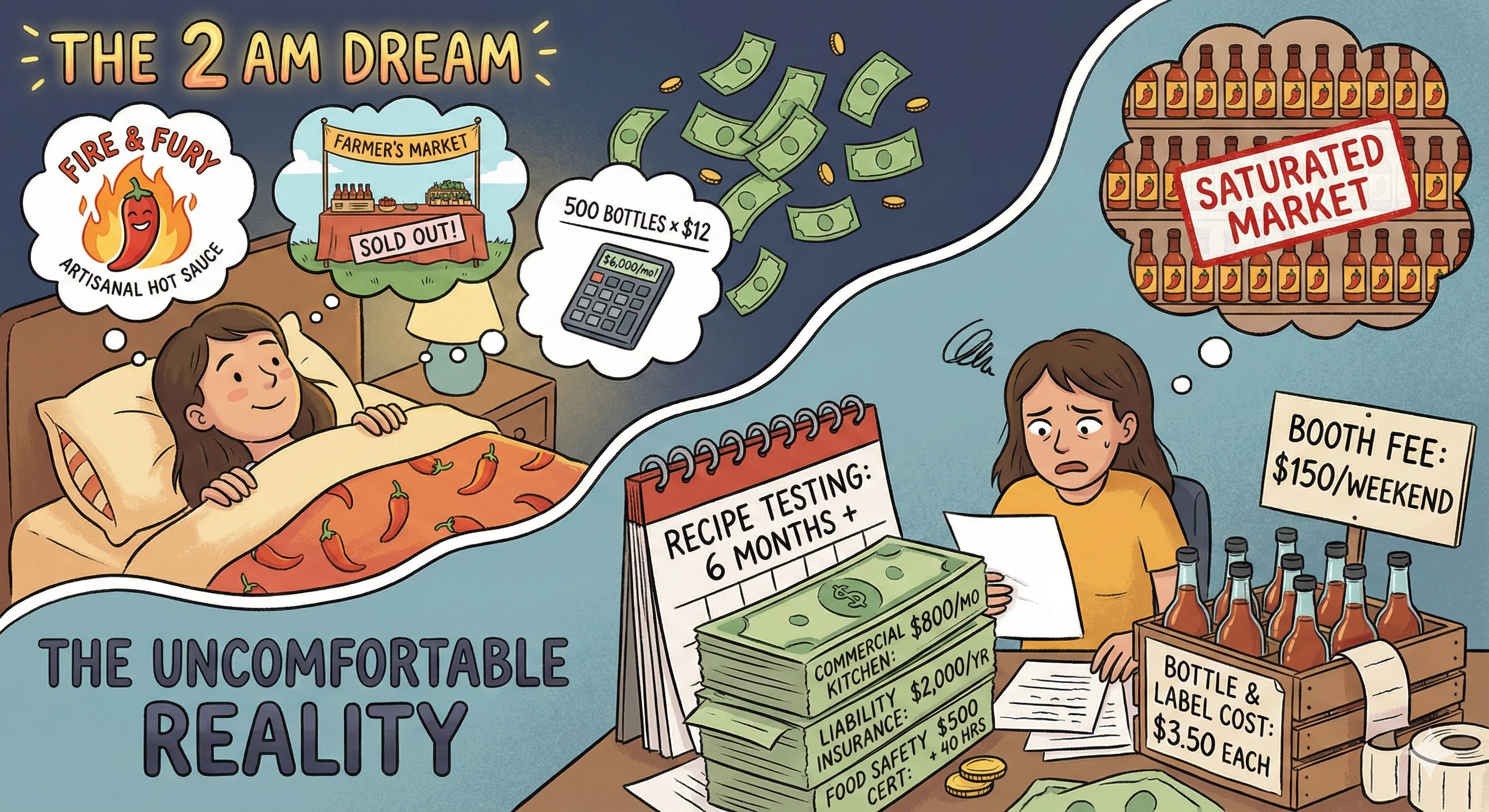
Somewhere in America right now, someone is lying awake at 2 AM, mentally designing the logo for their artisanal hot sauce company. They've already picked the name (something clever with "fire" in it), imagined the farmer's market booth, and calculated that if they sell just 500 bottles a month at $12 each, they'll be making $6,000—practically a mortgage payment.
What they haven't calculated: the commercial kitchen rental ($800/month), liability insurance ($2,000/year), food safety certification ($500 plus 40 hours of classes), bottle and label costs ($3.50 each at small volumes), farmer's market booth fees ($150/weekend), the six months of recipe testing, and the uncomfortable truth that the hot sauce market is absolutely saturated with passionate people who had the exact same 2 AM revelation.
This isn't pessimism. It's pattern recognition. Most side hustles fail not because the founder lacked passion or work ethic, but because they skipped the unglamorous work of stress-testing the idea before investing real money. They fell in love with the vision and outsourced due diligence to hope.
AI can't guarantee your business will succeed. But it can run your idea through a gauntlet of hard questions before you've spent a dime—the kind of questions a skeptical investor, an industry veteran, and a market researcher would ask if you were paying them $500/hour.
Why This Matters More Than You Think
The average failed small business costs its founder between $10,000 and $50,000 in direct losses, not counting the opportunity cost of hundreds of hours that could have gone toward something else. Worse, the psychological toll of a failed venture can make people gun-shy about trying again—even when their next idea might actually be viable.
The problem isn't lack of information. You can Google "how to start a [business type]" and find endless articles. The problem is that most of that information is written by people trying to sell you something: courses, tools, coaching, or the dream itself. What you rarely find is someone whose job it is to poke holes in your plan.
That's where AI becomes genuinely useful. It has no emotional investment in your idea. It won't tell you what you want to hear to protect your feelings. And when properly prompted, it will systematically stress-test your assumptions against market realities, competitive dynamics, and financial fundamentals.
Think of it as a pre-flight checklist. Pilots don't skip the checklist because they're excited to fly. They run it because they know excitement isn't a substitute for preparation.
The Side Hustle Sanity Check Framework
Before you spend money on LLCs, websites, inventory, or equipment, run your idea through these five lenses. Each one is designed to surface a different category of risk that passion tends to obscure.
Lens 1: Market Reality
Is there actual demand for this, or are you solving a problem only you have? Who's already serving this market, and why would customers choose you?
Lens 2: Unit Economics
Can you actually make money at realistic price points and volumes? What are the true costs, including the ones you haven't thought of yet?
Lens 3: Competitive Moat
What stops someone with more resources from copying you? What's your sustainable advantage?
Lens 4: Operational Reality
What does running this actually look like day-to-day? Do you have the skills, time, and temperament for the unglamorous parts?
Lens 5: Failure Modes
How does this business die? What are the most likely paths to failure, and can you mitigate them?
Now let's see how to use AI to examine your idea through each lens.
The Master Prompt: Your AI Advisory Board
Instead of asking AI generic questions, you'll prompt it to role-play as a panel of skeptical advisors—each with a different perspective on your idea. This "Team of Rivals" approach ensures you're not just getting validation from one angle.
THE SIDE HUSTLE SANITY CHECK PROMPT
I'm considering starting a side business. Before I invest any money, I need you to stress-test this idea from multiple perspectives. Be direct and critical—I'd rather hear hard truths now than lose money later.
The idea: [Describe your business concept in 2-3 sentences]
My situation:
- Available startup capital: [$X]
- Hours per week I can dedicate: [X hours]
- Relevant skills/experience: [list them]
- Timeline to profitability goal: [X months]
- Geographic market: [local/regional/national/online]
Analyze this idea through five lenses, with each section including specific questions I should answer and red flags to watch for:
- Market Reality: Who are my competitors? What's the realistic market size? Why would customers choose me over established alternatives?
- Unit Economics: What are ALL the costs I need to consider? What's a realistic price point? What volume do I need to break even?
- Competitive Moat: What's my sustainable advantage? How easily could someone copy this?
- Operational Reality: What does a typical week look like? What skills am I missing? What's the unglamorous work I'm probably not thinking about?
- Failure Modes: What are the three most likely ways this business fails? What early warning signs should I watch for?
End with a frank assessment: Is this idea worth pursuing as described, does it need significant modification, or should I walk away?
This single prompt will generate a comprehensive analysis. But the real value comes from going deeper on each lens with follow-up prompts. Let's walk through real examples.
Real-World Examples
Example 1: The Mobile Dog Grooming Van
SCENARIO: Sarah loves dogs and hates her corporate job. She's considering buying a used grooming van ($15,000) and starting a mobile dog grooming business in her suburban Texas town.
PROMPT
I'm considering starting a mobile dog grooming business in a suburban Texas town (population ~80,000). I'd buy a used grooming van for about $15,000 and have another $5,000 for supplies and marketing.
My situation: I can dedicate 30 hours/week initially while keeping my day job. I have no professional grooming experience but have groomed my own dogs for years. I want to be profitable within 6 months.
Run this through the five-lens sanity check. Be brutally honest about what I'm not thinking about.
KEY INSIGHTS FROM THE ANALYSIS
MARKET REALITY:
- In a town of 80,000, approximately 35-40% of households own dogs
- That's roughly 12,000-14,000 potential customers
- But: 3-4 established groomers already serve this market
- Mobile grooming commands premium pricing ($60-100 vs $40-60 for shops)
- Your target market is busy professionals willing to pay for convenience

RED FLAG: Without professional certification, you'll struggle to command premium prices that make mobile overhead worthwhile.

UNIT ECONOMICS YOU'RE MISSING:
- Van insurance (commercial): $200-400/month
- Gas at current prices for a heavy van: $400-600/month
- Water tank refills and waste disposal: $100-150/month
- Equipment maintenance and replacement: $100-200/month
- Grooming certification courses: $3,000-5,000 upfront
- Business insurance and bonding: $1,500-2,500/year

At $75/groom average, you need 15-18 grooms/week just to cover vehicle and operating costs before paying yourself.

FAILURE MODE ALERT: The most common mobile grooming failure is underestimating vehicle maintenance. A $3,000 transmission repair six months in can kill the business if you don't have reserves.
The Follow-Up That Changed Everything:
FOLLOW-UP PROMPT
Given those concerns, what if I started differently: got certified first, then worked part-time at an established groomer to build skills and a client base, THEN launched mobile in year two? Walk me through how that changes the risk profile.
This follow-up revealed a "stepping stone" approach that dramatically improved her odds: get certified ($3,000), work at a local groomer for 6-12 months (free skill-building, insider knowledge, client relationships), then launch mobile with proven skills, known demand, and potential clients who'd follow her. The van purchase moved from month one to month eighteen.
Example 2: The Print-on-Demand T-Shirt Store
SCENARIO: Marcus is a graphic designer who wants passive income. He's planning to create 50 original designs and sell them through Printful/Shopify with Facebook ads.
PROMPT
I'm a graphic designer wanting to start a print-on-demand t-shirt business. I'll create 50 original designs, sell through Shopify with Printful fulfillment, and drive traffic with Facebook ads. I have $2,000 for initial ads and setup.
Run the sanity check. I keep hearing this is easy passive income—tell me what's actually hard.
KEY INSIGHTS FROM THE ANALYSIS
THE "PASSIVE INCOME" MYTH:
Print-on-demand is one of the most oversaturated markets online. Here's the math that "passive income" gurus don't show you:

REALISTIC UNIT ECONOMICS:
- Printful base cost for a standard tee: $12-15
- Your selling price to compete: $24-28
- Your margin before ads: $9-16 per shirt
- Facebook ad cost per purchase (apparel average): $15-25
- Actual profit per sale after ads: Often $0 or negative

THE REAL GAME:
POD isn't a design business—it's a marketing business. Your designs are table stakes. Success depends on:
1. Finding underserved niches with passionate buyers
2. Building organic audience (no ad costs)
3. Creating designs that go viral within communities
4. Email list building for repeat customers

RED FLAG: $2,000 in Facebook ads will likely generate 80-130 store visits and 2-4 sales at typical conversion rates. That's not enough data to optimize, and you'll be out of budget before you learn what works.

FAILURE MODE: 90%+ of POD stores never make a single sale. The ones that succeed typically spent 6-12 months building audience through content before selling anything.
The Pivot That Made Sense:
After this reality check, Marcus asked AI to explore alternatives that better leveraged his actual skill (design) rather than competing in a marketing-driven commodity business. The analysis suggested: freelance design for established POD sellers (immediate income from existing skill), licensing designs to POD companies (passive income without marketing overhead), or building a design-focused Instagram/TikTok presence first (organic audience before product).
Example 3: The Wedding Photography Side Gig
SCENARIO: Jennifer has a nice camera and has shot friends' weddings as favors. She's considering going professional on weekends while keeping her teaching job.
PROMPT
I'm a teacher with a good camera (Canon R6) who's photographed three friends' weddings for free. They came out great and everyone says I should go pro. I'm thinking of booking weekend weddings at $1,500 each to start.
Give me the sanity check. What am I not seeing about turning a hobby into a business?
KEY INSIGHTS FROM THE ANALYSIS
THE HIDDEN HOURS PROBLEM:
A wedding isn't a 6-hour shoot. Here's the real time investment:

- Pre-wedding consultation: 2 hours
- Engagement session (expected at this price): 3 hours
- Wedding day: 8-10 hours
- Culling and selection: 4-6 hours
- Editing: 15-25 hours
- Client delivery and revisions: 2-3 hours
- Total: 35-50 hours per wedding

At $1,500, you're making $30-43/hour—before expenses.

EQUIPMENT REALITY:
Your Canon R6 is a great start, but professional wedding photography requires:
- Backup camera body: $1,500-2,500
- Second shooter for safety: $200-400/wedding
- Professional flash and lighting: $500-1,000
- Insurance (essential): $500-800/year
- Editing software subscriptions: $300-500/year

PRICING TRAP:
At $1,500, you're in the dangerous middle ground:
- Too expensive for "just need photos" couples
- Too cheap for couples expecting premium service
- Competing against established photographers with portfolios

FAILURE MODE: The most common failure is burnout. Teaching Monday-Friday then shooting/editing all weekend is unsustainable. Teachers who succeed typically shoot 10-15 weddings per year maximum, at $3,000+ to make the time worthwhile.
The Strategic Reframe:
The sanity check revealed that Jennifer's real question wasn't "should I become a wedding photographer?" but "what's the right entry point that doesn't destroy my weekends?" AI helped her explore alternatives: second shooter work for established photographers (paid training, no liability, flexible commitment), styled shoot collaborations to build portfolio without client pressure, or focusing on smaller events (elopements, rehearsal dinners) that require less time commitment.
Example 4: The Online Course Creator
SCENARIO: David is a senior accountant who wants to create a course teaching people to manage their small business finances. He's seen others make six figures selling courses.
PROMPT
I'm a CPA with 12 years experience. I want to create an online course teaching small business owners financial management—reading statements, cash flow basics, tax planning fundamentals. Price point around $297.
I see course creators claiming huge income. What's the reality check on this business model?
KEY INSIGHTS FROM THE ANALYSIS
THE COURSE CREATION REALITY:
Those "six-figure course creators" have something you don't: an existing audience. Here's what they're not telling you:

AUDIENCE-FIRST MATH:
- Typical course conversion rate from email list: 1-3%
- To sell 100 courses ($29,700 revenue), you need 3,000-10,000 qualified email subscribers
- Building that list organically: 12-24 months of consistent content
- Building that list with ads: $15,000-50,000 in ad spend

PRODUCTION COSTS YOU'RE NOT COUNTING:
- Course platform (Teachable, Kajabi): $100-400/month
- Video equipment and editing: $2,000-5,000 upfront
- Course production time: 100-200 hours for quality content
- Ongoing updates (tax law changes annually): 20-40 hours/year

THE REAL BUSINESS MODEL:
Successful course creators don't sell courses—they sell to their audience. The course is the product, but the business is audience building: YouTube, podcast, blog, social media.

COMPETITIVE MOAT PROBLEM:
"Financial basics for small business" is extremely crowded. Search YouTube—thousands of videos cover this for free. Your differentiation needs to be specific: "Financial management for Etsy sellers" or "Cash flow for seasonal businesses" creates a defensible niche.
The Better Path Forward:
David's follow-up prompts explored the "audience first" model. AI helped him design a 12-month content plan: start a YouTube channel with weekly 10-minute financial tips for small business owners, grow the email list through a free "tax planning checklist" download, launch a simple $47 mini-course at month six to test demand, then develop the flagship course once he had proof of audience and topic resonance.
Example 5: The Local Food Truck
SCENARIO: Miguel makes incredible tacos and dreams of a food truck. He's found a used truck for $35,000 and has family willing to invest.
PROMPT
I want to start a taco food truck in Austin, Texas. Found a used truck for $35,000. Family is willing to invest $50,000 total. I make amazing tacos—everyone who tries them says I should open a restaurant.
Give me the reality check on food truck economics and what could go wrong.
KEY INSIGHTS FROM THE ANALYSIS
AUSTIN FOOD TRUCK REALITY:
Austin has 1,000+ food trucks—one of the most competitive markets in America. The taco category alone has 100+ competitors.

TRUE STARTUP COSTS (AUSTIN):
- Used truck: $35,000
- Health department certification and permits: $2,000-4,000
- Commercial kitchen for prep (required): $500-1,500/month
- Insurance: $3,000-6,000/year
- Generator maintenance and fuel: $400-800/month
- Initial inventory and supplies: $3,000-5,000
- Commissary fees: $300-600/month
- City permits and location fees: $1,000-3,000/month for good spots
- Propane, water, waste disposal: $300-500/month

Your $50,000 covers maybe 4-6 months of operation before profitability.

UNIT ECONOMICS REALITY:
- Average taco food truck transaction: $10-14
- Food cost target: 28-32% ($3-4.50 per transaction)
- To net $4,000/month owner salary after all expenses: need 600-800 transactions monthly
- That's 25-35 customers per day, every operating day

LOCATION IS EVERYTHING:
The difference between a good spot ($300/day revenue) and a bad spot ($75/day) is the difference between thriving and closing. Prime Austin spots have waiting lists or exclusive arrangements.

FAILURE MODE: 60% of food trucks fail within three years. Top reasons: equipment breakdown without reserves, underestimating commissary/permit costs, and location problems. A single $5,000 repair without cash reserves can end the business.
The Risk Mitigation Strategy:
Rather than rejecting the dream, AI helped Miguel design a lower-risk entry: start as a weekend pop-up at farmers markets and breweries (test demand, build following, learn operations), work in an established food truck for six months (learn the business without capital risk), save aggressively to have $20,000 in reserves beyond startup costs, and only buy the truck after proving the concept and building a customer base.
Example 6: The Etsy Craft Business
SCENARIO: Lisa makes beautiful hand-poured candles and wants to sell them on Etsy.
PROMPT
I make hand-poured soy candles as a hobby. Friends buy them for $25 each and say they're better than store-bought. I want to sell on Etsy. I can make about 20 candles per week in my spare time.
Sanity check this—is handmade candle selling viable or am I walking into a crowded commodity market?
KEY INSIGHTS FROM THE ANALYSIS
THE CANDLE MARKET TRUTH:
Search "soy candle" on Etsy: 500,000+ results. This is one of the most saturated handmade categories.

YOUR REAL UNIT ECONOMICS:
Materials per candle (wax, wick, fragrance, jar, label): $6-9
Etsy fees (listing, transaction, payment processing): ~13% of sale price
Shipping supplies: $2-3
At $25 sale price, your margin is $8-12 per candle

PRODUCTION CAPACITY CEILING:
20 candles/week = $160-240 weekly profit maximum
That's $640-960/month before:
- Etsy ads (nearly required for visibility): $50-200/month
- Photography and branding: $200-500 upfront
- Insurance (required for selling anything with a flame): $300-600/year

THE VISIBILITY PROBLEM:
New Etsy shops get virtually zero organic traffic. The platform rewards:
1. Reviews (you have none)
2. Sales history (you have none)
3. Ad spend (you'll need this)
4. Repeat customers (takes time)

Expect 3-6 months before consistent sales, even with good products.

WHERE CANDLE BUSINESSES ACTUALLY SUCCEED:
- Hyper-specific niches: "candles for D&D players," "bookish candles," "candles for grief"
- Local wholesale: shops, spas, hotels (higher volume, lower marketing costs)
- Subscription models: predictable revenue, customer retention
- Scent customization: customers choose fragrance combinations
The Niche-Down Strategy:
Lisa's follow-up conversation explored what makes her candles different. She mentioned creating candles inspired by hiking trails she's visited. AI helped her develop a positioning around "National Parks candle collection"—specific scents for Yellowstone, Yosemite, Acadia, etc. This transformed her from "another candle seller" to "the outdoor adventure candle brand," with a built-in marketing story and a passionate niche audience.
Going Deeper: Follow-Up Prompts That Matter
The initial sanity check is just the beginning. These follow-up prompts extract more specific, actionable intelligence:
HIGH-VALUE FOLLOW-UP PROMPTS
- Competitive deep-dive: "Find 5 successful businesses in this exact niche. What are they doing right that I should learn from? What are they doing wrong that creates an opening for me?"
- Customer discovery: "What questions should I ask 10 potential customers before I invest anything? Give me a simple interview script."
- Financial stress test: "Model three scenarios: best case, realistic case, worst case. What revenue do I need in each to hit my goals?"
- Pre-mortem: "It's one year from now and this business has failed. Write the post-mortem. What went wrong?"
- Minimum viable test: "How can I test this idea with $500 or less before committing serious resources?"
- Alternative paths: "Given my skills and interests, what are three other business models I should consider that might be better fits?"
The Minimum Viable Test
Before committing real resources, every idea should pass through a low-cost validation phase. Here's a prompt to design yours:
MINIMUM VIABLE TEST PROMPT
For my [business idea], design a validation test I can run in 30 days or less with a budget under $500. The test should answer:
- Will strangers actually pay for this? (Not friends being polite)
- What price point resonates?
- What's my realistic customer acquisition cost?
- What objections do people have?
Give me specific action steps, not general advice.
For the taco truck, this might mean: host three paid taco nights at a friend's backyard ($200 in supplies), charge market rate ($12/plate), see if strangers from Facebook Marketplace actually show up and pay. For the candles: list 10 candles on Etsy with minimal investment, run $100 in ads, measure real conversion rates before ordering inventory at scale.
When to Walk Away
Not every idea deserves to be pursued. Here are the signals that should give you pause:
RED FLAGS THAT SUGGEST WALKING AWAY
- The math only works with optimistic assumptions at every step
- You can't articulate why customers would choose you over established alternatives
- The startup costs exceed what you can afford to lose entirely
- The time commitment conflicts with non-negotiable life responsibilities
- You're excited about the identity ("I'm a business owner") more than the work itself
- Everyone you ask thinks it's a great idea (they might just be being polite)
- The business requires skills you don't have and don't want to develop
Walking away from a flawed idea isn't failure—it's intelligent capital allocation. The goal isn't to start a business. The goal is to build something sustainable that improves your life.
When to Proceed
Conversely, here are signals that suggest your idea has legs:
GREEN LIGHTS FOR PROCEEDING
- The unit economics work even with conservative assumptions
- You've identified a specific underserved niche within a larger market
- You can test the concept with minimal investment before scaling
- You have relevant skills or a clear plan to acquire them
- The worst-case scenario is something you can absorb financially and emotionally
- Real potential customers (not friends) have expressed willingness to pay
- You're excited about the daily work, not just the end result
The Bigger Picture
AI isn't replacing the judgment calls you'll need to make as a business owner. It's accelerating the research phase—compressing weeks of Googling, reading, and guessing into focused analysis sessions. The founders who succeed typically share one trait: they're willing to hear hard truths early, when changing direction is cheap.
Your passion for an idea is valuable. It provides the energy to push through inevitable difficulties. But passion without validation is just expensive optimism. The side hustle sanity check doesn't kill dreams—it stress-tests them so the good ones survive contact with reality.
Run your idea through the framework. Ask the uncomfortable questions. If it survives the gauntlet, you'll proceed with confidence rather than hope. And if it doesn't? You've just saved yourself thousands of dollars and months of heartache—resources you can redirect toward an idea that actually has a shot.
KEY TAKEAWAYS
- Run every business idea through the five-lens sanity check before spending money
- Use AI as a skeptical advisor, not a cheerleader—prompt for criticism
- Design a minimum viable test ($500 or less) to validate demand with real customers
- The best time to discover fatal flaws is before you've invested
- Walking away from a bad idea is a win, not a failure
REMEMBER
- Passion is fuel, but validation is the compass
- The unglamorous work (permits, bookkeeping, marketing) is still your job
- Every successful entrepreneur has killed more ideas than they've pursued
Want to learn more? Check out Practical AI for Humans for more practical guides on using AI effectively.