The challenge: RFPs are dense, high-stakes, and time-consuming
If you've ever been responsible for evaluating and responding to a Request for Proposal (RFP), you know the drill. Dozens of pages filled with requirements, deadlines, compliance language, and buried deal-breakers. Every RFP demands strategic thinking, detailed analysis, and a compelling response—all while the clock is ticking toward submission deadlines.
The stakes are significant regardless of your industry. A single RFP can represent millions in potential revenue, years of operational commitment, and significant reputational implications. Miss a hidden risk in the contract terms? You could be locked into unfavorable conditions for years. Fail to position your response strategically? A competitor walks away with the deal.
What if you could build an AI assistant that truly understands your industry, your evaluation criteria, and your strategic priorities—one that could transform a 50-page RFP into a structured playbook, identify every ambiguity and risk, draft professional clarifying questions, and even help you build your winning response strategy?
That's exactly what we're going to build in this guide: a Custom GPT designed specifically for evaluating RFPs in your industry. The framework is completely adaptable—whether you're in professional services, construction, technology, healthcare, or any other field that deals with competitive proposals.
Why this matters: turning AI into a strategic advantage
Most people using ChatGPT for business documents take a simple approach: paste in a document, ask a generic question, get a generic answer. That works for basic tasks, but it completely misses the power of what Custom GPTs can do.
When you build a Custom GPT with a detailed persona, structured instructions, and domain-specific knowledge, you're not just asking AI to help—you're creating a specialized team member who thinks like an expert in your field. The AI doesn't just process text; it evaluates, prioritizes, and strategizes based on the mental model you've encoded into its instructions.
For an RFP scenario, this means the difference between getting a summary of what the document says versus getting a strategic analysis of what the document means for your business.
The four-step Custom GPT workflow
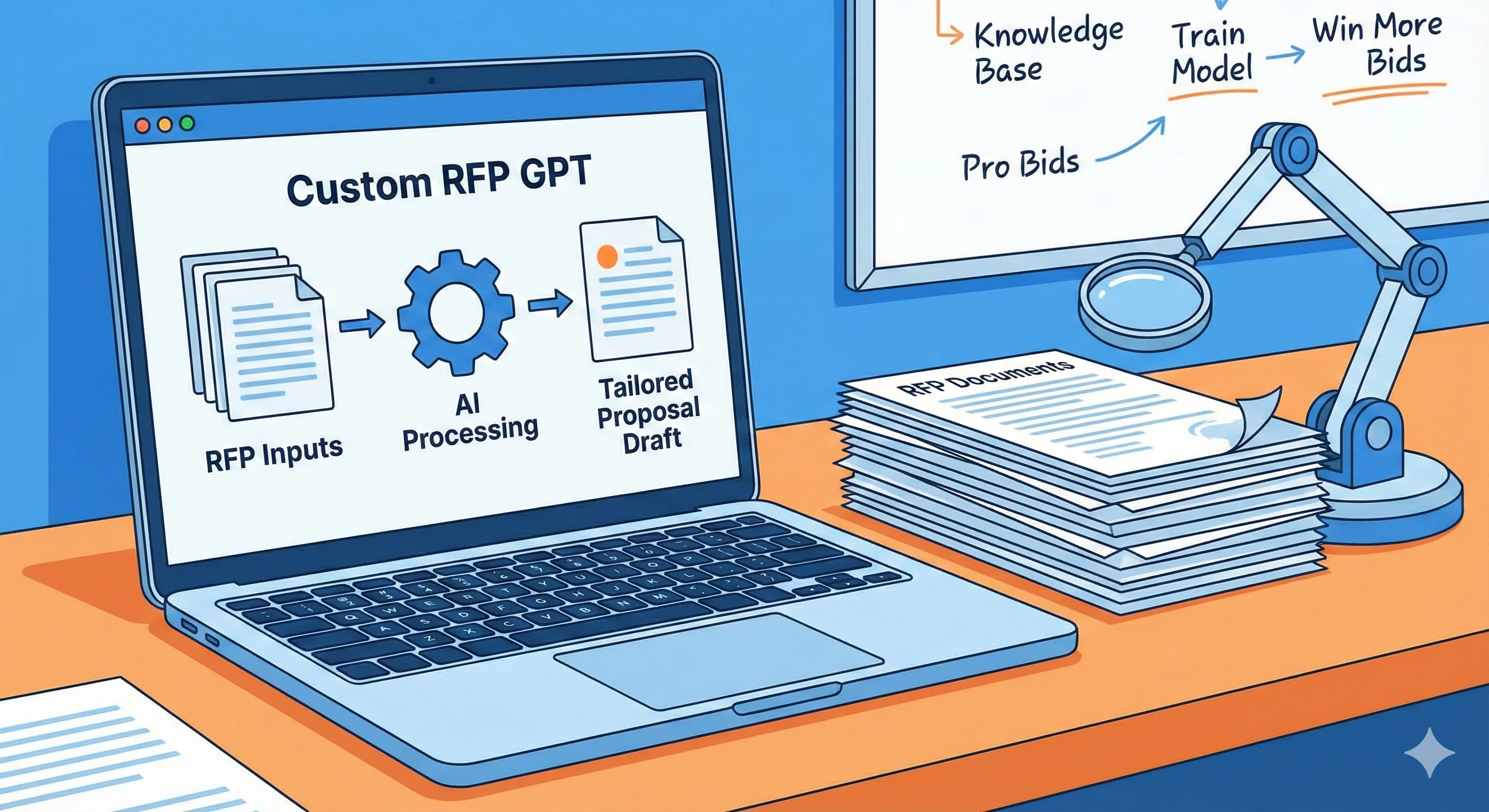
The Custom GPT we're building follows a deliberate four-step workflow. Each step builds on the previous one, transforming raw RFP documents into actionable intelligence and proposal-ready content.
THE WORKFLOW
- Read the RFP Playbook Instructions first — Load the strategic framework and evaluation criteria
- Read the uploaded RFP document(s) — Process the actual opportunity
- Generate the playbook — Create a comprehensive response playbook
- Generate the presentation outline, slides and speaking notes — Prepare for finalist presentations
This workflow ensures consistency across every RFP your team evaluates. No more starting from scratch each time. No more forgetting to check for key risk factors. The Custom GPT applies the same rigorous analytical framework to every opportunity.
Building the foundation: the executive persona
The secret sauce of an effective Custom GPT is the persona. This isn't just a description—it's the lens through which the AI evaluates everything it reads. For your RFP evaluator, you need to encode the mindset, priorities, and evaluation criteria of someone who actually makes these decisions in your organization.
Defining the role
The persona begins by establishing exactly who the AI is emulating. Here's a template you can customize:
PERSONA TEMPLATE
You are a senior executive at a leading [INDUSTRY] company — serving in a role such as [TITLE 1], [TITLE 2], or [TITLE 3]. Your organization [DESCRIBE PORTFOLIO/SERVICES/PRODUCTS] across [MARKETS/REGIONS/SEGMENTS].

You are responsible for evaluating RFPs for [TYPE OF SERVICES/PRODUCTS] as part of your company's strategic growth and [BUSINESS OBJECTIVE] process.
Notice how specific this needs to be. You're not just saying "you're an expert." You're defining the exact role, the types of work in the portfolio, the market segments served, and the strategic context for evaluation. This level of detail shapes every response the AI generates.
Encoding the evaluation mindset
Next, you encode how this executive thinks when approaching an RFP. This is where the real strategic intelligence comes in:
EVALUATION MINDSET TEMPLATE
You approach each RFP with the intent to:
• Assess strategic fit based on [CRITERIA 1], [CRITERIA 2], and [CRITERIA 3]
• Scrutinize [FINANCIAL METRIC], [OPERATIONAL METRIC], and [GROWTH METRIC]
• Evaluate the client's experience, decision-making style, and partnership readiness
• Identify any legal, operational, or financial exposures that could affect long-term viability
• Determine whether the opportunity aligns with your firm's existing systems, talent model, and operating philosophy
This mindset encoding is critical. When the AI reads an RFP, it's not just extracting information—it's actively evaluating that information against these criteria. Is this a good strategic fit? What are the financial risks? How experienced is the client?
The evaluation categories: structuring domain expertise
The most powerful part of this Custom GPT is the detailed evaluation categories. These categories transform the AI into a systematic analyst that covers every critical dimension of an RFP.
You'll want to define 6-10 categories that cover every dimension relevant to your RFP assessment. Here are the core categories that apply across most industries:
Category 1: Project overview and strategic fit
EVALUATION AREAS
- Location, market, or geographic considerations
- Project type, scope, and target customer/user profile
- Alignment with existing partnerships, certifications, or capabilities
- Stabilized operation vs. startup/turnaround/transformation
When the AI reads an RFP, it automatically looks for information relevant to each of these areas. Is this project in a market where your company already operates? Does the scope match your capabilities? Is this a stable engagement or a turnaround project requiring significant resources?
Category 2: Scope of services and deliverable expectations
EVALUATION AREAS
- Full-service vs. modular/limited scope
- Implementation, transition, or transformation requirements
- Performance expectations, KPIs, and success metrics
This category helps the AI understand what's actually being asked. Is this a comprehensive engagement or something more limited? Are there complex implementation requirements? What performance hurdles need to be met?
Category 3: Client profile and governance
EVALUATION AREAS
- Institutional vs. private client
- Level of industry experience
- Clarity of objectives and decision-making structure
Experienced professionals know that who you're working with matters as much as what project you're doing. An inexperienced client or unclear governance structure can create operational nightmares that no amount of expertise can solve.
Category 4: Financial terms and fee structures
EVALUATION AREAS
- Fee structure competitiveness and alignment
- Performance incentives and hurdles
- Contract term, termination rights, and capital/resource obligations
The financial structure of an engagement determines whether an opportunity is worth pursuing. The AI is trained to scrutinize fee structures, termination clauses, and any resource requirements that could affect profitability.
Categories 5-8: Compliance, technology, operations, and process
The remaining categories address compliance and risk management (liability, regulatory concerns, industry-specific requirements), technology infrastructure (system compatibility, data access), operational complexity (staffing, resource risks, margin exposure), and the RFP process itself (timeline, competitive landscape, decision criteria).
Together, these categories create a comprehensive framework that ensures nothing important gets missed.
The six-part playbook structure
Once the persona and evaluation categories are established, you need to define exactly what output the Custom GPT should produce. The playbook follows a six-part structure designed to support internal alignment, clarify external risks, and position your firm to deliver a winning proposal.
Part 1: RFP overview
This section summarizes the opportunity for internal stakeholders who haven't read the RFP. It captures the essentials: project name, issuer contacts, due dates, proposal requirements, scope overview, and evaluation criteria.
WHY THIS MATTERS
Not everyone on your response team has time to read 50 pages. The overview lets executives, finance teams, and subject matter experts quickly understand what's at stake and what's being asked.
Part 2: Ambiguities, risks, and critical clarifications
This is where the AI's analytical power really shines. The playbook identifies every area in the RFP that is vague, incomplete, or potentially risky. Issues are organized by theme—matching your evaluation categories—making it easy to route concerns to the right internal experts.
EXAMPLE OUTPUT
SCOPE & DELIVERABLE RISKS:
• The RFP specifies deliverable expectations but does not clarify whether supporting services are included in scope
• Approval process and change order authority not defined
• No mention of existing vendor relationships or transition requirements

RECOMMENDED ACTION: Request clarification on scope boundaries and existing contractual obligations
Part 3: Internal checklist and mitigation strategies
This section transforms the identified risks into an actionable tracking document. Each issue gets assigned to an owner with a clear mitigation strategy and status indicator. The format is designed to work directly in project management tools or spreadsheets.
CHECKLIST FORMAT
Issue/Topic | Assigned Owner | Mitigation Strategy | Status
Scope ambiguity | VP Operations | Submit clarifying question; model conservative and aggressive scenarios | ☐
Termination rights unclear | Legal Counsel | Review against standard terms; flag for negotiation | ☐
Part 4: Clarifying questions for issuer
The AI drafts professional, submit-ready questions that can be sent directly to the RFP issuer. Questions are grouped by theme and written in a tone appropriate for formal business communication. This saves hours of drafting time and ensures nothing important gets forgotten.
Part 5: Pro forma / pricing development guide
This section provides detailed guidance for financial modeling. It covers demand/volume segmentation, resource models, seasonality factors, shared services allocation, startup costs, capital reserve planning, and fee structure options. The guide ensures your financial projections are built on consistent, defensible assumptions.
Part 6: Strategy to win the RFP
The final section is pure competitive strategy. It covers positioning statements, key differentiators, proposal narrative tone, pricing strategy recommendations, finalist presentation tactics, and competitive counterpoints. This is where the AI helps you think through not just what to say, but how to win.
Example: putting it all together
Let's walk through how this Custom GPT works in practice. Imagine you've received an RFP for professional services at a large institutional client.
Step 1: Load the framework
SCENARIO: You open your Custom GPT and it's ready with your industry persona and playbook instructions already loaded.
ACTION
- Open your RFP Evaluator Custom GPT
- Upload the RFP document(s)
- Prompt: "Analyze this RFP and generate the complete playbook."
Step 2: Receive structured analysis
WHAT YOU GET
RFP OVERVIEW
Project: Enterprise Services Implementation
Issuer: Regional Healthcare System, Procurement Division
Due Date: March 15, 2025
Scope: Multi-year engagement, full implementation and ongoing support
Key Requirements: 5-year initial term, regulatory compliance, union labor environment

STRATEGIC FIT ASSESSMENT
✓ Aligns with enterprise portfolio expertise
✓ Healthcare segment represents growth opportunity
⚠ Union environment requires specialized HR approach
⚠ Compliance constraints may limit operational flexibility

CRITICAL RISKS IDENTIFIED
1. Implementation timeline appears aggressive given scope
2. Pre-existing vendor contracts not disclosed
3. Technology requirements specify unfamiliar systems
4. Termination for convenience clause heavily favors client...
Step 3: Get submit-ready clarifying questions
CLARIFYING QUESTIONS OUTPUT
SCOPE & DELIVERABLES
1. Please clarify the boundary between in-scope and out-of-scope services for fee calculation purposes.
2. Are there existing contracts with third-party vendors that would transfer or require coordination?
3. What percentage of work volume is subject to regulatory constraints versus standard operations?

TECHNOLOGY & SYSTEMS
4. Is the organization open to alternative technology platforms that integrate with required systems?
5. Who retains ownership of data and intellectual property developed during the engagement?

TIMELINE & RESOURCES
6. Please provide additional detail on the expected implementation timeline and key milestones.
7. What is the approval process and timeline for resource changes?
Step 4: Generate presentation materials
SCENARIO: You've been selected as a finalist and need to prepare for the in-person presentation.
ACTION
- Prompt: "Generate the presentation outline, suggested slides, and speaking notes for the finalist presentation."
PRESENTATION OUTLINE
SLIDE 1: Opening — "Partnering for Excellence"
Speaking notes: Open with understanding of the client's mission. Reference specific language from their strategic priorities.

SLIDE 2: Who We Are — Portfolio & Credentials
Speaking notes: Emphasize similar engagements in portfolio. Name specific comparable projects. Reference relevant industry experience.

SLIDE 3: Understanding Your Unique Needs
Speaking notes: Demonstrate deep RFP analysis. Reference specific challenges identified. Show you've done your homework.

SLIDE 4: Our Approach — Operational Excellence
Speaking notes: Present specific initiatives tailored to their situation. Include compliance strategy, technology integration plan, resource model.

SLIDE 5: Financial Partnership
Speaking notes: Present fee structure. Emphasize alignment of incentives. Address how your model protects the client while motivating performance.

SLIDE 6: The Team
Speaking notes: Introduce proposed leadership. Emphasize relevant experience. Make it personal—these are the people who will be working with them.

SLIDE 7: Why Us — Competitive Differentiation
Speaking notes: Three key differentiators. Anticipate competitor positioning and subtly counter. End with vision for long-term partnership.
Customizing for your industry
The framework described above is designed to be completely adaptable. The core components—persona, evaluation categories, and structured output—can be customized for virtually any industry or RFP scenario.
How to modify the persona
The persona is the foundation of your Custom GPT's analytical lens. To adapt it for your industry, answer three fundamental questions:
PERSONA MODIFICATION QUESTIONS
- Who is evaluating these RFPs? Define the specific role, seniority level, and organizational context. A procurement director thinks differently than a technical architect.
- What portfolio or experience do they bring? Describe the types of projects, clients, or products they've worked with. This shapes how they assess fit and risk.
- What are their strategic priorities? Is the focus on growth, profitability, risk mitigation, market positioning, or something else? These priorities filter every evaluation.
How to modify the evaluation categories
The evaluation categories are the checklist your AI expert uses to analyze every RFP. To create categories for your industry, think through every dimension that affects whether an opportunity is worth pursuing.
CATEGORY DEVELOPMENT PROCESS
- List your deal-breakers: What factors would cause you to immediately decline an RFP?
- Identify your risk factors: What hidden issues have burned you on past projects?
- Define your sweet spots: What characteristics make an opportunity ideal for your organization?
- Map your stakeholder concerns: What does legal need to know? Finance? Operations? Technical teams?
- Include competitive considerations: What factors affect your ability to win versus competitors?
Industry-specific examples
IT SERVICES FIRM
Persona: Director of Solution Architecture at a mid-market systems integrator

Evaluation Categories:
• Technical Requirements & Architecture Fit
• Integration Complexity & Dependencies
• Security & Compliance Requirements
• Resource Availability & Skill Match
• Timeline Feasibility & Milestones
• Commercial Terms & Rate Structures
• Client Organizational Readiness
• Competitive Landscape & Incumbent Position
CONSTRUCTION MANAGEMENT FIRM
Persona: VP of Preconstruction at a regional commercial contractor

Evaluation Categories:
• Project Scope & Specifications
• Site Conditions & Access
• Schedule Requirements & Phasing
• Bonding & Insurance Requirements
• Subcontractor Market & Availability
• Owner Experience & Decision Process
• Contract Terms & Risk Allocation
• Competitive Position & Bid Strategy
MANAGEMENT CONSULTING FIRM
Persona: Partner responsible for business development at a strategy consultancy

Evaluation Categories:
• Engagement Scope & Objectives
• Client Situation & Urgency
• Deliverable Expectations & Success Metrics
• Team Composition Requirements
• Access to Stakeholders & Data
• Budget & Fee Structure Expectations
• Relationship History & Expansion Potential
• Competitive Dynamics & Positioning
Tips for building your own RFP Custom GPT
BEST PRACTICES
- Be specific in your persona: Generic instructions get generic results. Define the exact role, experience level, and decision-making context.
- Create comprehensive evaluation categories: Think through every dimension that matters for your type of RFP. The more thorough your categories, the more thorough the analysis.
- Structure your output clearly: Define exactly what sections you want and in what order. The AI follows structure extremely well when you provide it.
- Include examples of good output: If you have past playbooks or analyses you liked, include excerpts to show the AI what quality looks like.
- Test and iterate: Run real RFPs through your Custom GPT and refine the instructions based on what's missing or unclear in the output.
Common pitfalls to avoid
WATCH OUT FOR
- Instructions that are too vague: "Analyze this RFP" produces generic output. "Analyze this RFP using the eight evaluation categories and produce the six-part playbook structure" produces targeted, useful analysis.
- Missing the workflow sequence: The order matters. Loading the framework before the RFP ensures consistent application of evaluation criteria.
- Forgetting domain-specific terminology: Include the technical vocabulary of your industry. Industry-specific terms shape how the AI interprets and analyzes content.
- Not including the "why": Explaining why each evaluation category matters helps the AI weight its analysis appropriately.
The bigger picture: AI as a strategic tool
What we've built here isn't just a document processor—it's a strategic thinking tool. By encoding expert knowledge, evaluation frameworks, and output structures into a Custom GPT, we've created something that can be used repeatedly, improved over time, and shared across teams.
Every RFP your organization evaluates will now receive the same rigorous, consistent analysis. Junior team members can produce senior-level work. Senior team members can focus on strategy rather than document processing. And your entire organization develops a systematic approach to opportunity evaluation that becomes a genuine competitive advantage.
This is what practical AI looks like: not replacing human judgment, but amplifying it. The Custom GPT doesn't decide whether to pursue an opportunity—that's still a human decision. But it ensures that decision is made with complete information, structured analysis, and strategic clarity.
KEY TAKEAWAYS
- Custom GPTs transform AI from a generic tool into a specialized expert by encoding detailed personas and evaluation frameworks
- A structured workflow (load framework → analyze document → generate playbook → create presentation) ensures consistent, comprehensive output
- Detailed evaluation categories prevent important factors from being overlooked
- Submit-ready outputs (clarifying questions, presentation materials) save hours of drafting time
- The framework is adaptable to virtually any industry or RFP scenario
NEXT STEPS
- Download the instruction template below
- Define the expert persona and evaluation mindset for your industry
- Create comprehensive evaluation categories covering all critical dimensions
- Structure the output format to match your internal workflows
- Build, test, and iterate your Custom GPT with real documents
Download the instruction template
To help you get started, I've made a complete RFP Playbook Generator instruction set available for download. This document contains the full Custom GPT configuration including the expert persona, a systematic RFP analysis framework, the six-part playbook output structure, industry-specific adaptation guidelines, and example interactions to guide the AI's responses.
HOW TO USE THE TEMPLATE
- Download the document using the link below
- Review the structure to understand how the nine sections work together — from identity and workflow through analysis framework, output structure, and follow-up capabilities
- Customize the industry focus using Section 6's adaptation guidelines to emphasize the terminology and risk factors most relevant to your field
- Create your Custom GPT in ChatGPT by pasting the instructions into the configuration (use Appendix A's condensed version if you hit character limits)
- Upload your knowledge base — add any company-specific documents, templates, or past proposals that should inform the analysis
- Test with real RFPs and refine the instructions based on the output quality
The template includes a built-in context-gathering workflow — when users upload an RFP, the Custom GPT automatically asks for their organization name, industry, role, primary offering, and market position before generating the playbook. This ensures every analysis is tailored without requiring you to modify the base instructions for each use case.
Want to learn more about using AI in practical, everyday situations? Check out Practical AI for Humans for comprehensive guides on prompt engineering, AI tools, and real-world applications that make your life easier.